
Virtual Try-On: AI-powered virtual dressing
A platform that dresses a person's photo in the chosen garment with AI, prepares product photos for a catalogue and connects to e-commerce sites via API.
- image generation in the fast setting (18 s before; internal measurement, October 2026)
- 11 simage generation in the fast setting (18 s before; internal measurement, October 2026)
- ready scenes: night club, wedding hall, restaurant, terrace, beach, city, office, studio
- 8ready scenes: night club, wedding hall, restaurant, terrace, beach, city, office, studio
- independent services: dressing and product extraction, each with its own permission and quota
- 2independent services: dressing and product extraction, each with its own permission and quota
Situation
When buying clothes online, customers decide without seeing how the garment will look on them. A retailer's product photos are not uniform either: some on a mannequin, some on a hanger, some laid flat, some on a model.
The goal was to turn these mixed product photos into a dressing-ready catalogue, show the product realistically on the customer's own photo, and offer it as a service that plugs into the retailer's existing website.
Scope
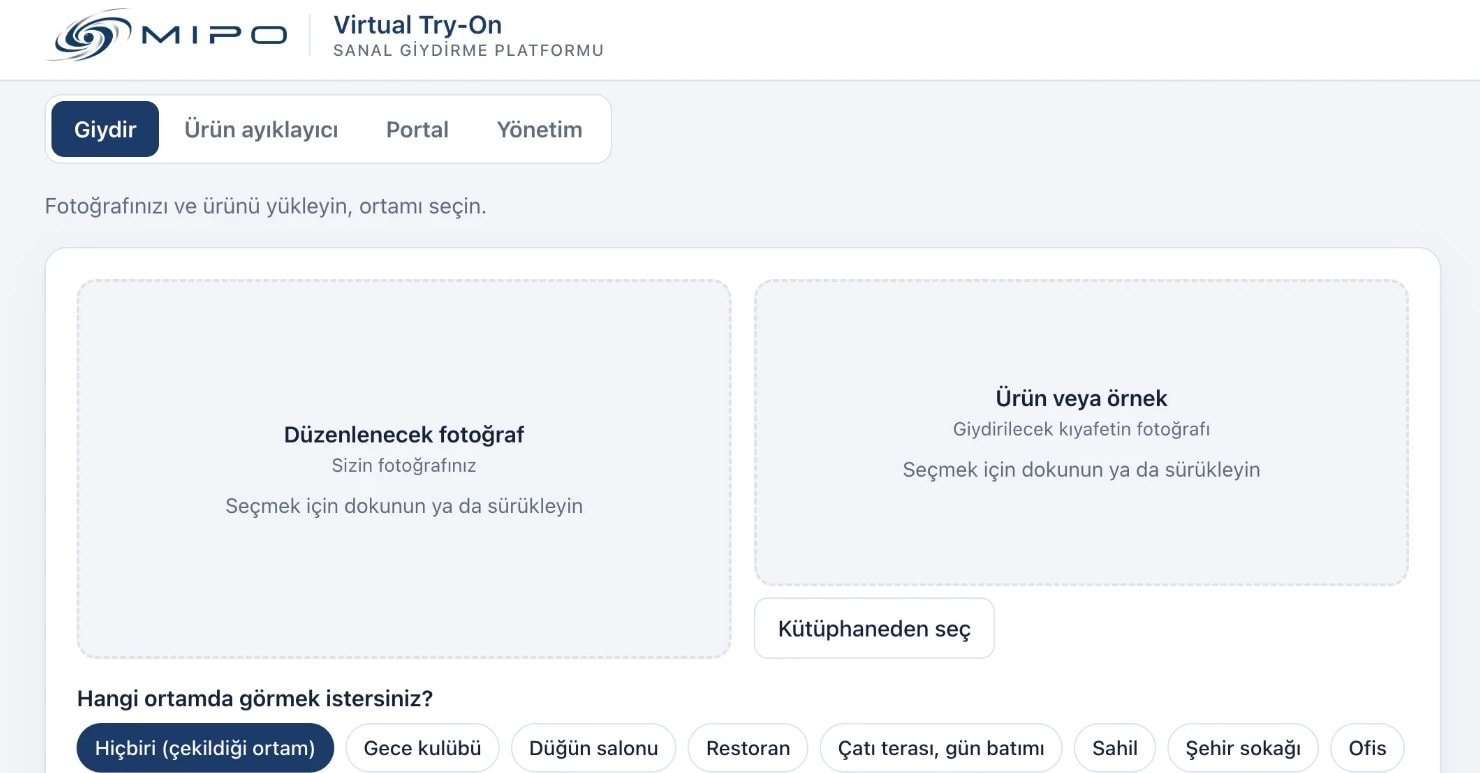
- Dressing: upload a person photo and a product; result shown with a before/after comparison, version history, download and retry
- Scene selection: the original setting, or night club, wedding hall, restaurant, rooftop terrace, beach, city street, office and studio scenes
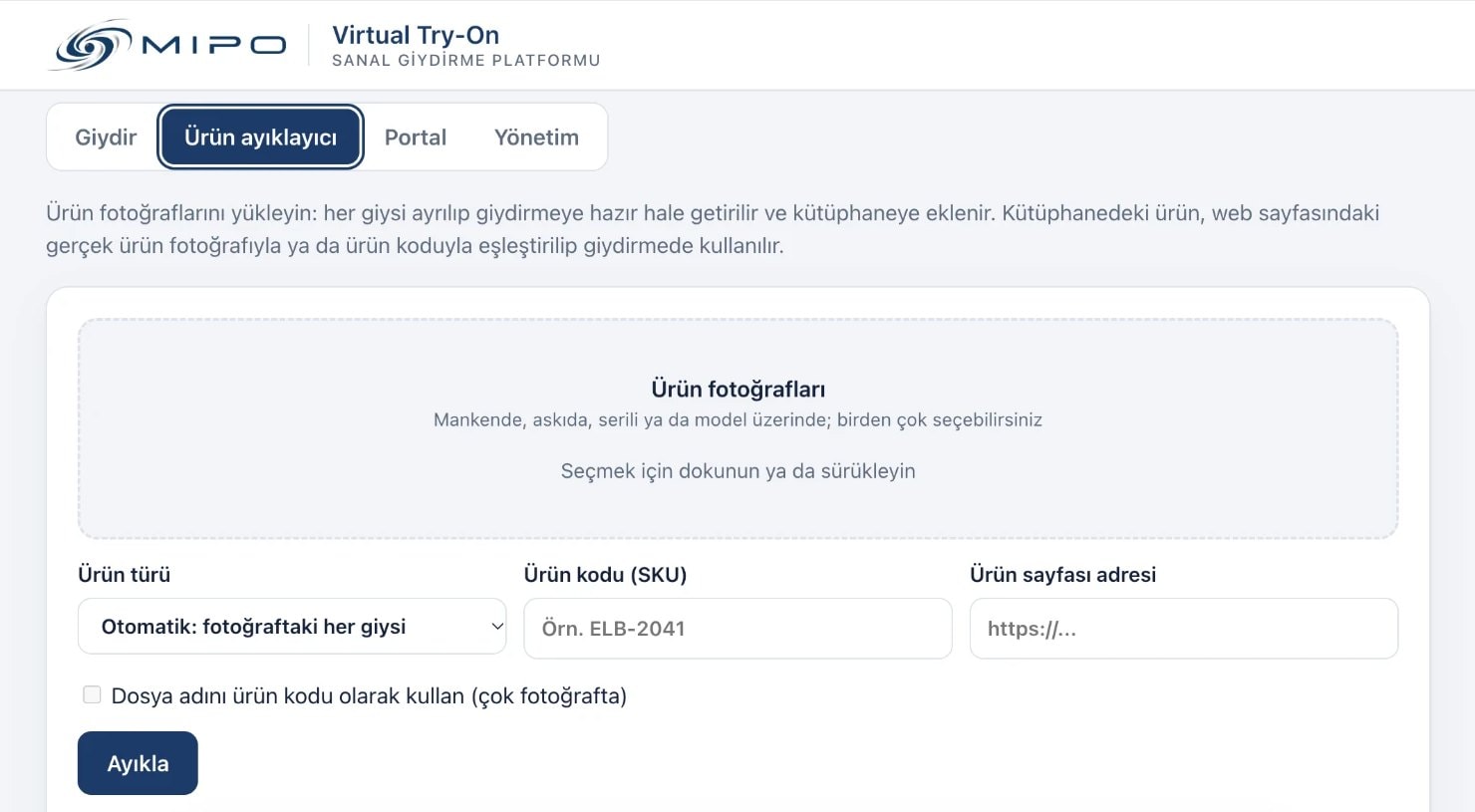
- Product extractor: separates every garment in a photo and adds it to the library; matching by SKU and product page URL, bulk upload
- Web photo matching: finds the library item from the product photo on the site
- REST API and API-key endpoints for connecting e-commerce sites
- Client portal: connections, access details, job history, reports, team and account; daily, monthly and credit-based usage limits
- Administration: clients, reports, audit log and settings; multi-tenant structure (a separate account per client)
Implementation
Product extraction prepares two images per garment: an exact pixel cut-out from the photo and a clean product image of the garment on its own (parts hidden behind arms, hair or the mannequin are completed). Dressing uses the pixel cut-out, which gave the most faithful result in an internal blind comparison; if the cut-out fails inspection, the clean image is used.
For scene changes the person and the garment are separated into layers, the background is regenerated, a shadow is added under the feet and the person is scaled to the scene's perspective. Light matching is optional: when on, the scene lighting is applied to the person; when off, the person's image is left untouched.
Every result goes through automatic inspection. The user first sees an uninspected preview, and the final result arrives after inspection. A correction request changes only the relevant garment area in the selected version.
To connect a store's site there are endpoints for querying the library, matching by photo, starting a job and fetching the result; preparation can start as soon as the customer's photo is selected to shorten the wait.
Result
The platform is live, running in Mipo's internal use and with client accounts. Duration, error rate and cost of every job are tracked in the admin panel; development continues.
In the fast generation setting, image generation dropped from 18 to 11 seconds. In a blind comparison of eight jobs by three judges, this setting produced the result most often ranked first (internal experiment, October 2026).
On our own GPU servers
Image generation runs with an open-weight image editing model on Mipo's own server across two GPUs. Customer photos are not sent to third-party AI services.
Every result is inspected
Preservation of the person, garment and shoes is measured in code; in scene changes, feet touching the ground is checked separately. A preview appears immediately, the final result arrives after inspection.
Multi-tenant with quotas
Each client has separate permissions for dressing and extraction, daily, monthly or credit-based quotas, concurrency and per-minute request limits. Quota movements are kept in an append-only ledger.
Easy to plug into stores
An e-commerce site connects to the REST API with an API key or to an embeddable widget. The widget runs with a 15-minute signed token and only on an allowed domain; no API key ever reaches the browser.
Single sign-on with MipoID
Teams sign in with their mipobt.com account. Sessions, roles and activity logs are synchronised with the Mipo admin panel; closing the account closes platform access too.
Secure access
HTTPS and HSTS, upload size limits and brute-force protection on sign-in. API keys are never stored in plain text; every admin action is written to an immutable audit log.
Planning a similar project?
Tell us the current state; we'll fix the scope and timeline in writing.